If you’re over 40, there’s a good chance your relationship with exercise has changed.
Maybe in your 20s and 30s, cardio was the main event. An hour-long cardio class, a treadmill workout, or anything that made you sweat and burn as many calories as possible probably felt like a productive workout.
I know that’s how I used to think about exercise.
Strength training was often an afterthought for me. Maybe I’d lift weights for 5–10 minutes at the end of a cardio class—or skip it altogether.
But as we get into our 40s and 50s, the conversation around exercise starts to change. We’re hearing more and more about the importance of strength training, building muscle, and maintaining bone density.
So does that mean you should forget about cardio?
Absolutely not.
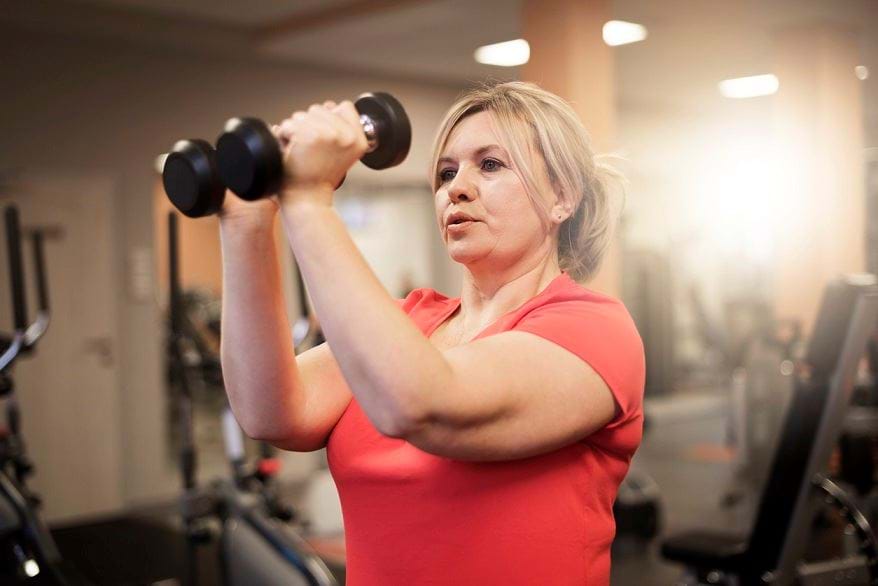
Both strength training and cardio have important benefits. But if your workout time is limited, I believe women over 40 should prioritize strength training.
Here’s why.
As we age, we naturally begin to lose muscle and bone density.
That doesn’t mean we’re destined to become weak or frail. It means we need to be more intentional about maintaining—and ideally building—strength.
The muscle we’re most concerned with when we talk about strength training is skeletal muscle—the muscle attached to your bones that allows you to move, lift, walk, climb stairs, carry groceries, and do all the things you want to do in your daily life.
As we get older, we gradually lose skeletal muscle if we don’t actively work to maintain it.
That’s why strength training is so important.
We’re not just trying to preserve the muscle we have. We can build new muscle, even in our 40s, 50s, and beyond.
Building muscle and getting stronger can help you stay active, mobile, and capable as you age.
And that’s a much more important goal than simply seeing a certain number of calories burned on your fitness tracker.
Bone density tends to decrease as we age, particularly for women around and after menopause.
Weight-bearing exercise and strength training supports bone strength.
It’s not just about how your body looks today. It’s about helping your body remain strong and capable for years to come.
Think about what you want your 60s, 70s, and 80s to look like.
You want to be able to travel. Carry your luggage. Get up off the floor. Carry groceries. Play with your grandchildren. Hike. Garden. Move through your daily life without constantly worrying about whether your body can handle it.
Strength training helps you build the physical capacity to do those things.
That’s why I don’t want women to think of strength training as simply a way to “tone up.”
It’s an investment in the body you want to have later.
Yes!
Cardio is absolutely important for cardiovascular health, endurance, and overall fitness. It can also be great for your mental health.
Going for a brisk walk can help you clear your head, reduce stress, get some vitamin D, and simply feel better.
And walking is one of my favorite forms of cardio. I love going for a walk and listening to a podcast.
The problem isn’t cardio. The problem is when cardio becomes the only type of exercise you’re doing because you believe you need to burn as many calories as possible.
If you have limited time to exercise, I’d rather see you spend that time getting stronger.
I completely understand why women sometimes avoid strength training.
Walking into the dumbbell section of a gym can feel intimidating. There may be more men than women, you may not know what exercises to do, and you may worry about doing something incorrectly or hurting yourself.
So how can you make strength training more approachable?
You don’t need a huge gym or a room full of equipment to get started.
There is an enormous amount of free strength training content available online. Look for beginner-friendly or low-impact workouts on YouTube if you’re just getting started.
If free weights feel intimidating, gym machines can be a great place to begin.
They can feel more approachable because the movement is often more guided.
A strength training class gives you an instructor who can demonstrate the exercises and help you learn how to use the equipment.
And don’t be afraid to talk to the instructor before class.
If you have questions, limitations, or an old injury you’re concerned about, tell them. That’s part of their job.
A good trainer doesn’t just hand you a generic workout.
They choose exercises that are appropriate for your body, your experience level, your limitations, and your goals.
For women who are nervous about getting started, having someone guide you through the process can make strength training feel much less intimidating.
And you don’t necessarily have to meet with a trainer in person.
Online personal training provides customized workouts that you can complete at home or in a gym, while still giving you accountability and support.
A trainer creates your workouts so they’re balanced and right for you, monitors your progress, gives you accountability to stay consistent and cheers you on.
If you have the time and enjoy different types of exercise, there’s nothing wrong with doing a variety of activities.
But most of us don’t have unlimited time.
If you’re trying to decide where to put your workout time, I’d prioritize strength training.
For most of my clients, I recommend:
3 days of strength training per week
and
2–3 additional days of brisk walking or other cardio.
Your exact routine may look different depending on your fitness level, goals, schedule, and any physical limitations.
Your cardio doesn’t need to be extreme. A brisk walk that gets your heart rate up is a great place to start.
You don’t have to choose between strength training and cardio.
You need both.
But as women get into their 40s and beyond, strength training deserves to move from the sidelines to the center of your fitness routine.
Cardio helps keep your heart and lungs healthy. Strength training helps you maintain and build muscle, support your bones, and stay strong and capable as you age.
So if you’ve spent years measuring a good workout by how much you sweat or how many calories you burned, it might be time to change the way you think about exercise.
Don’t just exercise to burn calories. Exercise to build a body that can keep doing the things you love.
And if strength training feels intimidating, start small. You don’t have to walk into a gym and pick up the heaviest dumbbells in the room.
You just need to start.